

Summary: Astronomers have witnessed the rare, complete lifecycle of a cosmic storm ‒ from breakout to calming down ‒ in a distant quasar, a supermassive black hole actively devouring matter. By tracking the variations of the X-ray light emitted by the quasar over a period of two decades, researchers revealed a powerful wind of dense gas erupting from the black hole’s violent immediate environment. This gas temporarily blocked our view of the quasar before finally dispersing. Remarkably, at its heyday this wind was strong enough to heat up gaseous matter far beyond the black hole’s sphere of influence. The observed transfer of energy from the black hole’s immediate environment to the inner part of the galaxy, has long been theorised by astronomers as an important process for understanding galaxy formation and evolution.
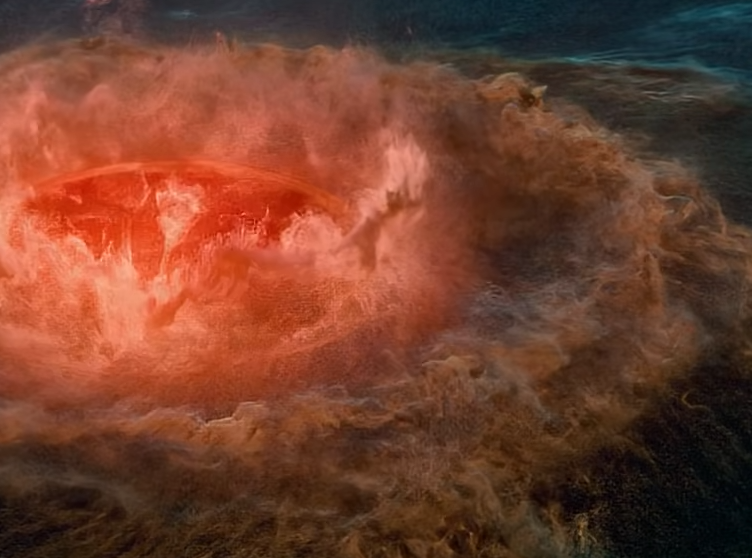
An international team of astronomers led by the National Observatory of Athens has observed the rare, complete lifecycle of a “quasar storm,” watching it brew, rage, and eventually lull into calm.
Most massive galaxies in the universe, including our own Milky Way, host at their centres black holes that weigh millions or even billions of times the mass of our Sun. The strong gravitational pull of these beasts captures matter, mostly gas, making it spiral inward and eventually fall in them, growing their masses even more.
Matter however, does not just disappear quietly. The intense gravity and friction heat it up to incredible temperatures, generating huge amounts of energy that is radiated away into space as brilliant light. It is this light that our telescopes can see. When a supermassive black hole is actively feeding and generating this powerful light show, we call it a quasar.
A cosmic storm in three acts
Researchers at the National Observatory of Athens have been studying the X-ray light of a sample of quasars when they discovered that one of them, designated 2MASS J14302580+4159572, behaved strangely. Its X-ray light showed unexpectedly extreme intensity variations over a period of about twenty years.
“The X-ray light intensity variations of 2MASS J14302580+4159572 are caused by dense warm material—in the form of gaseous clouds—moving in front of the source”, explains Athanassios Akylas, lead author of the study from the National Observatory of Athens. “This material blocks our view of the quasar and partially absorbs the X-ray light it produces.”
While such “obscuring” events are not uncommon, there is something unique about 2MASS J14302580+4159572: following the “obscured” phase lasting for about 17 years, the clouds began to disperse allowing the light of the quasar to shine through once again and its X-ray intensity to recover.
“This cycle is best understood as a wind of outflowing gas ejected by the quasar itself”, says Antonis Georgakakis, co-author of the study, also from the National Observatory of Athens. “The wind first blows dense material in front of the source, partially covering it and blocking our view to the quasar. Then the wind eventually subsides, the intervening matter diffuses and disperses, clearing up the light-path to the quasar.”
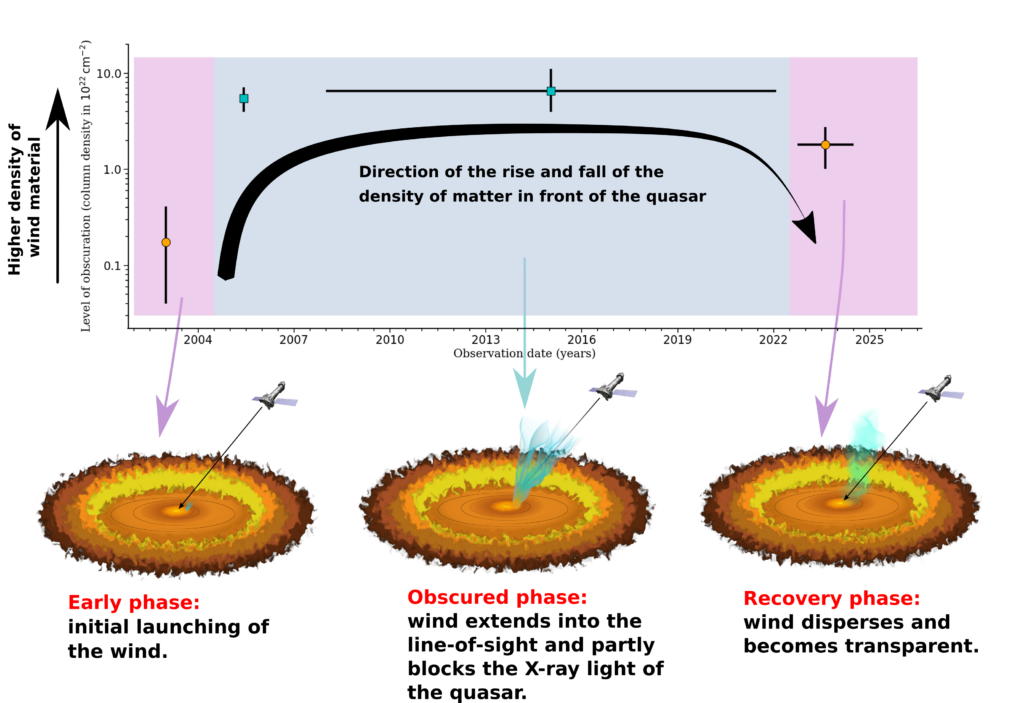
This interpretation is graphically demonstrated in the picture below. The top panel illustrates the observed rise and fall of the warm gas density along the line of sight to the quasar between 2002 and 2024. The bottom panels show three snapshots of the quasar that illustrate what is likely happening: in the early phase (left), the wind is just being launched and has not yet reached our line of sight. Next comes the obscured phase (middle), when the wind has fully developed and now crosses our line of sight, absorbing part of the quasar’s X-ray light. In the final recovery stage (right), the wind weakens and the warm gas density along our line of sight falls again.
Quasar winds traveling to large distances
The environment around rapidly growing black holes is thought to be violent and highly dynamic. The energy released as matter spirals into the black hole is so immense that it actually pushes some of the material away, creating powerful winds of gas that blast outward. These winds are blowing out even as new material is spiraling in.
Optical observations taken before the onset of the storm and during its peak in 2MASS J14302580+4159572 reveal that the material ejected by the wind traveled vast distances from the black hole, eventually colliding with the interstellar medium of the host galaxy. This interaction affects the surrounding gas, changing its temperature, density but also its ionisation state, i.e. stripping gas atoms of their electrons. These changes can be observed as subtle variations in some optical emission lines produced by the interstellar gas before and after the storm broke out as demonstrated in the picture below.
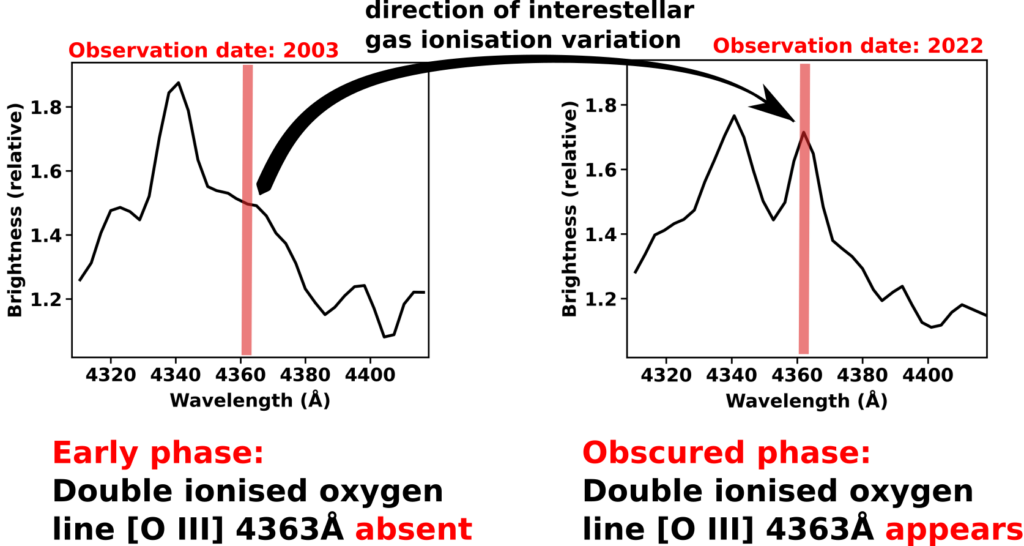
Changes in the interstellar gas before the onset of the storm and during its peak, as traced by a certain optical emission line — that of double ionised oxygen ([O III]). On the left, a small section of the optical spectrum of 2MASS J14302580+4159572, observed in 2003 during an early phase of the system, before the storm broke out. On the right, the same spectral region observed in 2022, near the peak of the storm (obscured phase). The appearance of the double ionised oxygen line traces changes in the temperature, density, and ionisation of gas in the galaxy’s inner regions — likely linked to the wind ejecting material to large distances.
The energetic interplay between quasar winds and the interstellar medium is considered a crucial step for understanding how galaxies evolve. Discoveries like 2MASS J14302580+4159572 offer a rare opportunity to witness — almost in real time — how outflowing material from a quasar travels outward, interacts with, and gradually reshapes more distant regions of its environment, leaving an optical echo of the same eruption seen in the X-rays.
The research leading to these results has been funded by (i) the Horizon Europe Framework Programme of the European Union Grant Agreement No. 101168906 TALES and (ii) the Hellenic Foundation for Research and Innovation (HFRI) project 4MOVE-U grant agreement 2688, which is part of the programme “2nd Call for HFRI Research Projects to support Faculty Members and Researchers”. This research uses observations from ESA’s XMM‑Newton mission, NASA’s NuSTAR mission and the UK Swift Science Data Centre at the University of Leicester. The optical spectra are from the Sloan Digital Sky Survey (SDSS) and the Dark Energy Spectroscopic Instrument (DESI).